
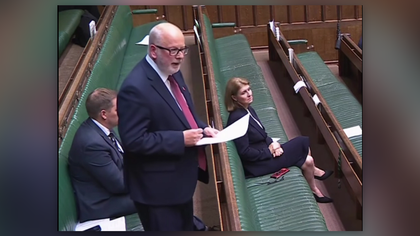
The possibility of forcing HMOs to be turned back into family homes in areas where there are too many “can’t be off the agenda”, says Mansfield MP Steve Yemm – though it would be almost impossible to do so under current laws.
The number of HMOs (houses in multiple occupation), where rooms are rented out to individual, unrelated tenants, has increased in recent years for a number of reasons.
But Mr Yemm has led a campaign against an oversaturation of them in his hometown, hosting a parliamentary debate on the issue and calling for the local council to take action by considering introducing legislation that means developers need to apply for permission to create one.
Nearly a year after Mr Yemm first mentioned the issue in parliament, Mansfield District Council agreed to look into the possibility of an HMO crackdown.
But if brought in, the legislation – called an Article 4 direction – would only mean that prospective HMOs would need permission, not those that already exist.
Mansfield District Council’s Executive Mayor Andy Abrahams said that while many details of the prospective Article 4 direction were yet to be determined, there “will be no requirement from property owners to retrospectively apply for licences or planning permission should an Article 4 be implemented.”
Asked by the Local Democracy Reporting Service whether Mansfield would just have to accept that those already in existence would remain in place, Mr Yemm suggested there could or should be action in the future to revert HMOs in areas where concentrations are “way above” where they should be.
He said: “Maybe there should be a test on streets to say, you know, you’re way above where you should be in terms of the concentration of HMOs – everybody’s going to have to reapply. Maybe there’s a case for that.”
“I haven’t really thought it through, but I’m open to the idea if it’s a real problem on certain streets. It’s a big undertaking but, you know, it can’t be off the agenda. I don’t think there’s a legal way to do it right now, but if people feel strongly about it and they’ve got really high concentrations of HMOs on their street, I think it’s something that’s worthy of consideration.”
But could it actually happen?
The law
Part of Mansfield District Council’s upcoming research into whether an Article 4 is needed will examine the areas in Mansfield that are particularly concentrated with HMOs.
But those that do exist already will have followed all the rules when they came into existence.
With no Article 4 in place, HMOs for between three and six residents don’t need permission under permitted development laws.
And currently, Article 4 directions cannot have retrospective effect, so where development has been lawfully carried out under a permitted development right, an Article 4 direction cannot therefore remove planning permission.
If a development was permitted when it was carried out, it remains lawful.
Dr Nell Munro, professor of law at the University of Nottingham, says she thinks that it would be “very difficult” for any new laws to compel property owners to apply for retrospective permission for their HMOs.
However, even if Mansfield District Council could do that and subsequently refused an application, the existing tenants of the HMO would have rights under the UK’s Renters’ Rights Act, the Human Rights Act 1998, and the European Convention on Human Rights (ECHR).
The Renters Rights Act, introduced this year, means that a tenant of a rented property can no longer be evicted without good reason, as they previously could under Section 21 of the Housing Act 1996.
If planning permission was hypothetically revoked and the landlord proposed to sell the property so it could be reverted, however, the tenants could be evicted under Section 8 of the Housing Act.
Alternatively, if permission was revoked and a landlord continued to operate the property as an HMO, the council could take enforcement action up to and including the courts.
In that case, selling the property, which would allow the tenants to be evicted, would be the best or maybe even the only option for a landlord.
However, Dr Munro says that landlords could also protect themselves under Article 1, Protocol 1 of the ECHR, which protects people’s right to “the peaceful enjoyment of possessions” – in this case, the landlord’s right to use their property without interference and run a business from it if they want to.
Dr Munro said: “I think it would be very difficult to (require permission) retroactively. I think it could potentially be an interference with human rights, would be very problematic and runs afoul of the government’s existing policy to promote tenants’ rights. I can’t see how you could make that work. It boggles the mind a bit.
“The ECHR protects the private right to property, and the landlord could say (the council is) forcing me to sell the property rather than maintain it as an asset.
“Otherwise the tenants would have to remain because of their protected rights under the Renters’ Rights Act. It seems an inescapable puzzle. I just can’t see how you could do it retroactively while being consistent with the law. If the only way to enforce the revoked permission is to get the tenants out, (by) forcing the landlord to sell the property, then I think you’re on a hiding to nothing.”
As well as the district council confirming its approach, the Ministry of Housing Communities and Local Government (MHCLG) has no current plans to revise rules on landlords being required to retrospectively gain permission under Article 4 directions.
 Village community centre set to be torn down for GP expansion
 Shoplifting suspects pulled over within minutes
 Stags beaten by rivals Chesterfield
 Patrols stepped up after exposure incidents
 Special Christmas memorial service in Mansfield
 Paedophile unmasked by messages on girl's phone
 Road improvements continue across Mansfield and Ashfield
 Remembrance Sunday parade in Mansfield