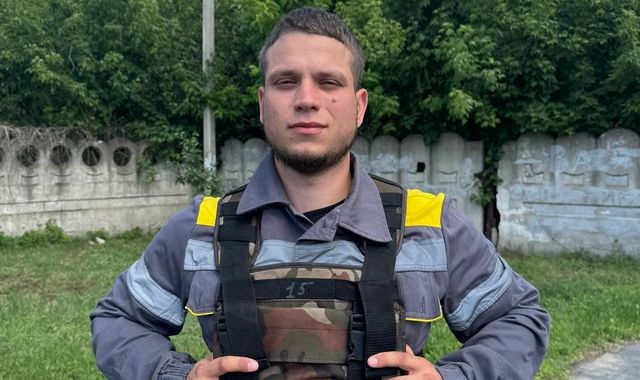
"The first thing the guys and I do is look at where we can hide."
When drone and missile strikes destroy power lines and plunge Ukrainian homes into darkness, it is Maksym and his colleagues who go out to fix them.
"They've chased us more than once. An FPV [first person view] drone hit our vehicle, and a mortar was firing right next to us," he tells Sky News.
Another drone was seen above them, helping the Russian mortar crew aim and re-aim their attacks.
"There's danger every time," he says.
Maksym lives and works in Nikopol, a city in southern Ukraine separated from Russian troops by the Dnipro River.
The city regularly comes under attack, with the district being shelled nearly 20 times in a single day earlier this month.
Maksym is a foreman for DTEK Dnipro Grids, which supplies electricity to homes and businesses.
He comes from a family of electricians.
Before the full-scale invasion in 2022, his work was more predictable.
"We did scheduled work on modernising the power grids: we installed new lines, put in transformers, and dismantled old equipment that was no longer suitable for our networks."
But now everything is much harder. Danger is a constant presence as he and his team go out to fix power lines and infrastructure blown up by drones.
"We have constant shelling from mortars and artillery, and a great many drones: FPVs, molniyas and small fixed-wing drones.
"Every day some crews are working, repairing damage after enemy strikes.
"Danger constantly follows us while we're doing the work," he says.
As winter approaches, Russia is expected to once again hammer Ukraine's energy infrastructure to try to plunge Ukraine's citizens into darkness.
The work Maksym and his colleagues do - getting the lights back on and heating working as quickly as possible - is crucial.
Much of the damage he repairs is along the banks of the Dnipro River - the only thing separating Nikopol from Russian-occupied territory.
"Since they can't cross it, thanks to our defence forces, [Russian troops] use everything they can to reach us on this side."
Maksym and his team cannot go out at night, because they will be too visible on the enemy's thermal cameras.
When they arrive on site, the first thing they do is find a place to hide and take shelter in case of drone attack. But speed is still key.
"You immediately look for a house, or a basement, or big trees that you can run to. The main thing is not to be spotted straight away. If they spot you, they won't let you work.
"So the main thing is to get the job done quickly, before they see you."
During one callout, they were inspecting a power line when they heard that a drone was coming. They took shelter.
"Where we had been standing, the drone flew around for five minutes, looking for us."
Fortunately, it didn't spot them, and they were able to get the work done.
But during the 40 minutes they were on site, there were seven or eight drones in the area.
Energy workers like Maksym are not always as lucky.
In June, a Russian drone killed a worker when he was out performing emergency power repairs in Kherson.
In Kyiv, four energy workers died in the space of about a month last winter.
More from Lives Under Fire:
Underground raves on Ukraine's frontline
Ukrainian veteran lost 25kg as a PoW
Psychologist helping Ukrainian veterans
With the constant danger at home and at work, why would Maksym stay? Other areas of Ukraine are (relatively) safer, after all.
"Why I stayed is a hard question," he says. "I like my job. I like my crew. It's a second family."
"All the guys want to work; they want to go out on restoration jobs and help residents, because in every district there are relatives, friends and acquaintances who are without electricity.
"We are doing everything in our power to bring the light back to their homes."

(c) Sky News 2026: Ukrainian energy workers dodging drones to bring people's electricity back
 Man charged with raping woman on Brighton beach
 Man rescued after being lured to remote villa in Spain where he was held for 15 hours, tied up and beaten
 Man, 21, dies after being found seriously injured in hospital car park
 At least 11 dead after suspected cartel leader 'El Chapo Isidro' captured in Mexico