The New Zealand election count has ended without a definitive result as the two main parties remain almost deadlocked in the popular vote.
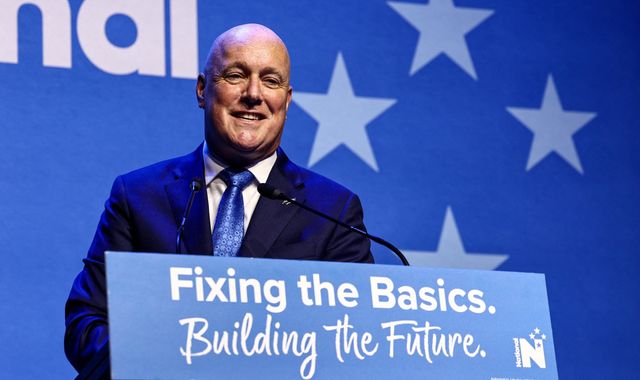
Incumbent Prime Minister Christopher Luxon said that even though the result was "too close to call", his centre-right National Party has a "pathway to forming the next government".
There was no definitive winner on election night on Saturday, but Mr Luxon's conservative coalition, which includes libertarian ACT and populist NZ First, could secure a wafer-thin majority.
But if Mr Luxon wants to remain in office, it could take weeks of negotiations and rely on votes counted after election day.
Mr Luxon did not claim victory in a speech to supporters at National's headquarters in the capital Auckland.
"National is once again the largest party in parliament and we have a pathway to forming the next government," he said.
"But I have to tell you right now it is too close to call."
The left-wing bloc, led by Labour Party leader Chris Hipkins, appeared to have fallen short of a majority.
"Tonight, New Zealand has spoken," he told supporters.
"It may take us a little bit longer to figure out exactly what it is that you've said."
The deadlocked result follows an election campaign that has been dominated by concerns about healthcare, housing and the state of the economy.
Under New Zealand's Mixed Member Proportional (MMP) voting system, voters don't elect prime ministers, but instead cast two votes, one for their preferred party and one to select a local representative.
Parties must either win a constituency seat, or win 5% of the preferred party vote, to enter parliament.
To govern, a coalition of parties must hold more than half of parliament's seats.
The total number of seats is determined by official calculations on election night based on quirks of the country's vote.
There are 120 seats in New Zealand's parliament, comprising 71 constituency seats and at least 49 party seats.
More from Sky News:
More bomb threats to flights in Europe
Two dead after bus school bus crash
But this total number can increase in cases of overhang.
This is where a party wins more electorate seats than the total share of seats it would otherwise be allocated based on its share of party votes.
Saturday figures showed there could be a 130-seat parliament, with 66 seats needed for a majority.
However, parties negotiating shared governing arrangements would prefer a more comfortable margin. Results suggested a coalition of National, ACT and NZ First would hold 67 seats, a number that has fluctuated.
Official results will not be announced until 27 November after special votes, which include those from overseas voters or people outside their electorate, are counted, which have historically tended to favour the left.
The vote count so far has suggested several prominent members of the National's frontbench could lose their seats, including financial minister Nicola Willis, speaker Gerry Brownlee, defence minister Paul Goldsmith and attorney-general Chris Bishop.
New Zealand's electoral system makes coalition governments the norm, with the tightness of this year's race meaning smaller parties will likely play a role.
Relative newcomer, the Opportunity Party, looks set to enter parliament for the first time, with the party's leader Qiulae Wong saying she would negotiate with whichever party won the most votes.
"We made that call based on the fact that we need a majority of seats in parliament in order to form a government. So that is what we will stick to," she told public broadcaster TVNZ.
New Zealand has slowly emerged from a prolonged economic downturn, with growth subdued, household budgets strained and unemployment rising to 5.7% in the third quarter, its highest level in 11 years.

(c) Sky News 2026: No clear winner after New Zealand general election
 Travel delays feared on Remembrance Sunday as fog warning issued for parts of England
 Thousands turn out to greet Pope Leo as he begins Latin America tour
 Man appears in court charged with murder of missing woman Carrie Mullane in Northern Ireland
 Deep forces are reshaping America's electoral map - and what it means for the 2028 presidential election